Many ecommerce teams say they have a PIM system and treat it as a box ticked. However, the more important question is
whether it’s the right one – one that genuinely speeds up day-to-day work. Every PIM has its strengths and limitations, but when a system is slow, hard to use, or inflexible, it creates trouble: product teams get frustrated, time-to-market is slow, and scaling product content becomes unnecessarily expensive. That was exactly NuBuiten’s experience – and ultimately what pushed them
to rethink their approach.
Client Spotlight: Meet NuBuiten
NuBuiten is a fast-growing
Dutch specialist in outdoor living. With deep roots in the timber trade, they help customers design and build complete outdoor spaces
. As the business grew, so did the demands on product information: richer content, more variants, more product dependencies, and, of course, higher expectations from online shoppers.
Situation before Pimics: an existing PIM that couldn’t scale
NuBuiten had already worked with a PIM system, but the team felt its limitations every day. Performance and usability issues slowed product data workflows and made day-to-day work more difficult than it needed to be.
At the same time, the expectations were rising:
NuBuiten had one online shop up and running + a fixed launch date for a new online shop. The combination of an existing PIM that was no longer efficient enough and a time-sensitive e-commerce launch created a clear need to rethink the underlying setup.
Moreover, NuBuiten’s brand philosophy has always been rooted in helping customers approach outdoor projects thoughtfully. They want their customers to understand what they’re choosing, why they’re choosing it, and what it delivers. This makes the need for accurate and reliable product data simply non-negotiable.
Once it became clear that their existing solution couldn’t support this ambition, NuBuiten decided that
the new online shop would be powered by data managed and enriched with Pimics.
The decision was made, and we got started
From our very first contact to a working solution, the project took
approximately five months (with Christmas and New Year’s holidays in between). This shows that a PIM implementation doesn’t have to take more than a year –
even when the goal is as ambitious as launching a brand-new online shop.
More importantly, this wasn’t just about “implementing a PIM” as an isolated IT deliverable. The goal was to help NuBuiten move faster, publish more consistent product content, and fill up the new online shop with
data that reflects real complexity –variants, sizes, colours, cross-references, and more – without overwhelming the customer.
Implementation journey: what we built – and why it matters for real-world e-commerce
Master category tree + feature model
We established a
scalable product structure that standardises how items are described. This creates
consistency across teams and makes it
easier to onboard new product ranges without reinventing the model every time.
SharePoint connection for files and assets
Rather than introducing a completely new way of working, we
connected Pimics to a source NuBuiten already uses. This keeps product assets
accessible, while reducing copy-paste work and preventing version chaos.
~300 rules to drive a secondary category tree
We implemented
feature-based classification rules that automatically generate an additional navigation-oriented structure. For e-commerce, this is crucial:
it improves product findability, supports filtering, and keeps navigation coherent even as the assortment grows.
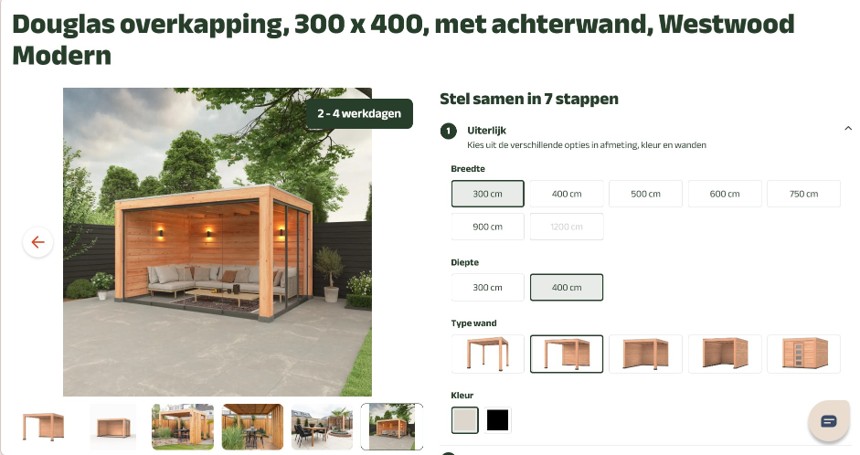
Data support for a multi-step configurable online shop
NuBuiten’s customers don’t just buy individual products – they build complete solutions. We prepared the product data so
the online shop can guide users through each step of the configuration process, helping them make the right choices while keeping the journey straightforward.
Extensive cross-references for add-ons and dependencies
We modelled “other products”, recommended add-ons, and configuration dependencies so the online shop can suggest compatible items. The result is a buying experience that guides customers rather than confusing them – while also
supporting upselling and reducing incorrect orders.
4 main benefits in summary:
- Replaced an underperforming PIM with a faster, more flexible setup – without losing momentum on day-to-day operations.
- Enabled the central management of around 9,000 items from one reliable source of truth.
- Launched a new online shop on a structured, scalable product data foundation (categories, rules, assets, and dependencies) in ~6 months.
- Enabled a better buying experience through guided configuration and smart cross-references – supporting findability, compatibility, and upselling.
“Our products can be quite complex, with different variants, options
and accessories that all need to work together in the webshop configurator.
Pimics gives us a clear way to manage these relationships and makes
the everyday work with product data much more efficient
for the whole team.”
Alexander van Slooten
Managing Director
Your takeaway
If you already run a PIM but it’s slowing down product data preparation and launches, it may be time to consider a replacement. The right PIM is not just a repository – it’s an engine for faster go-to-market and better customer experience.
The key to the success of this fast-moving project was the clarity of its purpose. This was not a 'feature comparison' project, but rather a performance-driven replacement.
This case study shows that the right PIM can transform product data into a well-structured, manageable system for the team – while making that data more useful, understandable, and actionable for customers. That is what sets “having a PIM” apart from “having a PIM that actively improves your e-commerce performance”.
Would you like to discover more?
Let’s connect!